Picture a Monday morning. A patient in their seventies arrives for a follow-up, carrying a plastic bag of boxes and a hospital discharge letter that doesn’t quite match what your system says they take. Somebody has to work out which version is true, and then write it down so the next clinician doesn’t have to repeat the exercise.
That’s medication reconciliation: comparing what a patient is actually taking against what the record says they should be taking, resolving the differences, and documenting the outcome. It sounds administrative. It isn’t. A clean reconciliation is one of the cheapest safeguards you have against harm, and the documentation is what makes it count.
Most practices already do some version of this. The trouble is that it’s done informally, in a quick chat at the end of a consultation, and then recorded inconsistently or not at all. This article looks at how to build a method you can repeat, what to write down, and how to keep it from swallowing your day.
Medication reconciliation process step by step
A workable process has five moves, and none of them needs to take long once it’s routine. Start by collecting every source: the existing record, the patient’s own account, any bags or boxes they’ve brought, pharmacy information, and recent letters from hospitals or specialists. Ask specifically about things people forget to mention, such as creams, inhalers, eye drops, vitamins, herbal products and over-the-counter painkillers.
Next, compare. Set the sources side by side and mark anything that differs: a dose, a frequency, a drug that appears in one place but not another. Then resolve each difference. Sometimes the answer is simple, like a dose that was changed by a specialist. Sometimes you need to phone the pharmacy or the prescriber, and that call should be noted too.
The fourth move is the clinical decision. For each item, someone with prescribing authority decides to continue, change, pause or stop it, and the reason goes on the record. Finally, communicate. The patient should leave knowing what they’re taking and why, and any other provider involved should receive the updated list.
Building an accurate medication history is the foundation of all this. Open questions work better than closed ones. “Tell me how you take your tablets on a normal day” will surface far more than “Are you still on your blood pressure pill?”, because people tend to agree with whatever you suggest.
Timing matters as well. Reconcile at the points where medicines tend to change: new patient registration, after any hospital stay or specialist visit, when a repeat prescription is renewed, and at routine reviews for people on several medicines. The World Health Organization’s work on digital health is a useful reminder that these transitions of care are exactly where information gets lost, which is why they deserve a fixed place in your workflow.
Medication list documentation: what to write and how
Your patient medication list is only as good as its last update. A list that was accurate eighteen months ago is arguably worse than none, because it looks authoritative. So the first rule is that every entry should carry enough detail to be read cold by someone who has never met the patient.
For each medicine, record the name, strength, form, dose, frequency, route, and the indication if you know it. Add the start date, who started it, and its status: active, paused or stopped. Note the date and the person who last verified it. Allergies and adverse reactions belong alongside the list, with the reaction described rather than just labelled, since “intolerant” can mean anything from mild nausea to anaphylaxis.
Then there’s the matter of what to do when something changes. Good record keeping principles, as set out in the Medical Protection Society’s guide to record keeping, say entries should be legible, made at the time, factual and complete. Corrections should be dated and signed, with the original entry left visible. Never overwrite a stopped drug as though it never existed. A struck-through or inactive entry with a reason (“stopped, ankle swelling”) protects the patient and you.
Free text has its place, but structured fields do the heavy lifting. Structured entries can be searched, checked against allergies and compared across visits. Use the free-text note for the thinking behind a decision, such as why you kept a drug that guidelines might question, and keep it short. The National Academy of Medicine makes a similar argument in its work on care-centred clinical documentation: limit notes to what is clinically essential, and design the record around the care, not around everything that could be captured.
One small habit pays off disproportionately. At the end of a reconciliation, add a single line stating that the list was reviewed with the patient on that date, and what was found. Six months later, that line answers the question “did anyone actually check this?” in about three seconds.
Medication discrepancies and patient safety
Discrepancies are the whole point of the exercise, so it helps to know what they usually look like. The common ones are omissions (a regular medicine missing from the record), duplications (the same drug under a brand and a generic name), dose differences, and drugs that were stopped elsewhere but still sit on your list as active. Each is a quiet route to prescribing errors, because the next person to issue a repeat will trust what’s in front of them.
Not every discrepancy is a mistake. Some are deliberate: a specialist reduced a dose, a patient decided to stop a tablet because it upset their stomach. The documentation needs to separate intentional changes from unintentional ones, since only the second kind is an error to be fixed. Record which it was, and what you did about it.
Think about the patient who stopped their statin after reading something alarming online, and never said so. Your record shows them as protected; they aren’t. A reconciliation conversation that asks, without judgement, “Are there any you’ve stopped or skip sometimes?” catches that, and your note of the answer changes the next consultation.
Where the stakes are high, such as anticoagulants, insulin, opioids and drugs with narrow safety margins, be stricter. Confirm the dose with a second source, and write down how you confirmed it. For older patients on many medicines, a periodic review that looks at whether each item is still needed is part of the same job.
It’s also worth tracking discrepancies at practice level. If you notice the same type of gap appearing after hospital discharges, for example, that’s a process problem you can fix with a standing call to the local pharmacy or a discharge-letter check. International bodies such as the OECD publish extensive work on patient safety and quality, and the consistent message is that systems, not individual vigilance, reduce harm.
Keeping documentation light enough to sustain
Reconciliation fails when it feels like extra typing. The evidence on record burden is blunt: the American Medical Association reports on organisations that cut clicks and alerts and freed significant time for doctors in the EHR, including through shared templates and reorganised screens. Some of those gains came from small changes rather than new technology.
Templates help, provided they’re short. A reconciliation template with six fields people actually fill in beats a twenty-field one that gets skipped. The American Academy of Family Physicians offers practical guidance on reducing administrative and documentation burden, and one theme is delegation: a trained nurse or pharmacist can collect the initial medication history, leaving the prescriber to review and decide.
Ambient tools are emerging too. The AMA has described a large rollout in which AI scribes saved thousands of hours of documentation in a year. If you try anything like that, treat the output as a draft: medicines are exactly the content where a misheard dose does damage, so a clinician must check the list before it’s saved.
Where GoodX fits into the picture
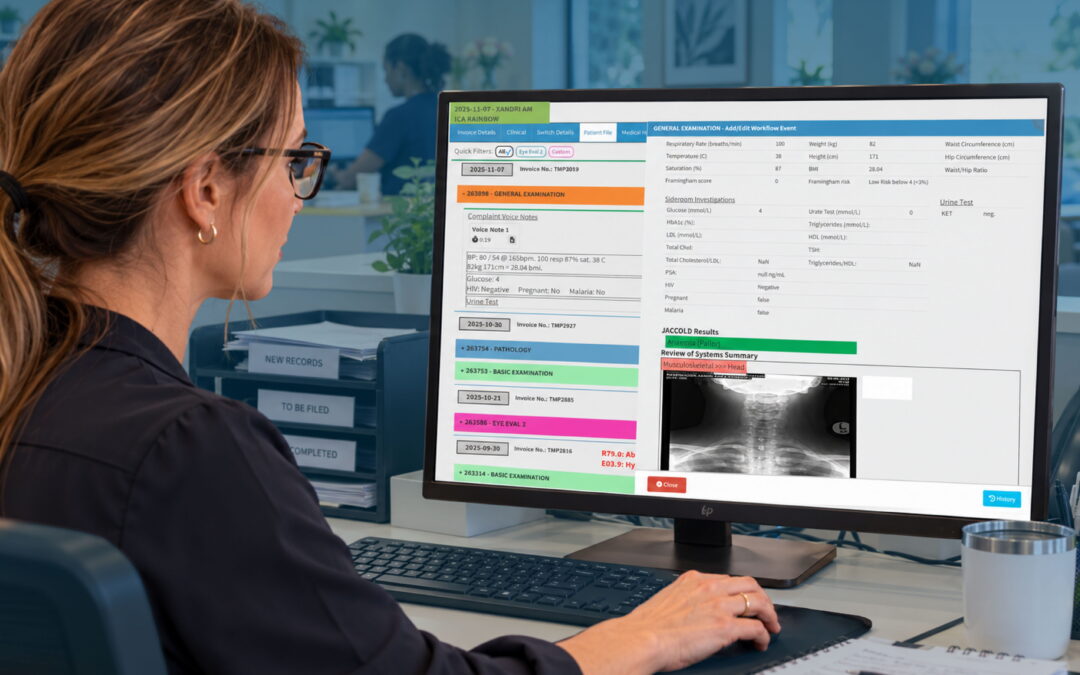
Good reconciliation depends on the medication record sitting inside the same system as everything else, so that nobody has to hunt across screens. GoodX practice management software keeps clinical records, bookings, billing and reporting together, which means a patient’s medication list is available at the point of care and updates are visible to the whole team. That cuts the duplicate typing that drives people to skip steps.
Practically, it helps in a few ways. Consistent clinical records make it easier to see when a list was last reviewed and by whom, and routine tasks around the consultation can be automated so clinicians spend their time on the decision, not the paperwork. Reporting gives you a view of how often reviews are happening, which is hard to know from memory. If you’re comparing systems, [INTERNAL LINK: how GoodX supports clinical records -> GoodX clinical records page] is a sensible place to start, and [INTERNAL LINK: reducing admin with practice automation -> GoodX automation page] covers the time-saving side.
Whatever software you use, the usability point from the American Academy of Family Physicians’ EHR guidance holds: weigh how a system feels in a real consultation, not only what it lists on a features page. Ask to see a medication review done end to end, with your own kind of patient.
Frequently Asked Questions
What is medication reconciliation?
Medication reconciliation is the process of comparing a patient’s actual medicines with the record, resolving any differences, and documenting the result. It draws on the patient’s account, prescriptions, pharmacy information and recent letters, and ends with an updated, shared medication list.
When should medication reconciliation be done?
Do it at every transition and review point: new patient registration, after hospital admissions or specialist visits, when repeat prescriptions are renewed, and at regular reviews for patients on multiple medicines. Any time a medicine changes, the list should be checked and updated.
What should a medication record include?
Each entry should show the drug name, strength, form, dose, frequency, route, indication, start date, prescriber and status. Add allergies and reactions, plus the date and person who last verified the list. Reasons for stopping or changing a medicine should also be recorded.
Who can carry out medication reconciliation?
Several team members can take part. Nurses, pharmacists or trained staff often gather the medication history, but a clinician with prescribing authority should review discrepancies and make the decisions. Local regulations and practice policy determine exactly who may do what.
How do I correct an error in a medication list?
Add a dated, signed correction and leave the original entry visible, in line with good record-keeping practice. Note what was wrong, what is now correct and how you confirmed it. Then inform the patient and any other providers who hold the earlier version.
Book your free GoodX demo
If you’d like to see how a joined-up record can make medication reviews quicker and easier to document, book a free demo with the GoodX team. You can walk through a realistic reconciliation with your own workflow in mind. Start at goodx.international.
Disclaimer: This article is provided for general informational and educational purposes only. While GoodX Software takes reasonable care to ensure that the information is accurate and current at the time of publication, laws, regulations, industry standards, healthcare policies and technology may change. The content should not be regarded as medical, legal, financial or other professional advice. Readers should verify information relevant to their circumstances and consult an appropriately qualified professional where necessary. GoodX Software accepts no responsibility for decisions made or actions taken solely on the basis of this content.